Protein
Weighted heavily to protect muscle during rapid weight loss. Appetite drops before protein needs do.
Compared on medication tracking, GLP-1 nutrition, side effects, coaching, and what the free tier actually includes — not star ratings.
GLP AI is the app behind this comparison. We have tried to be accurate and fair about every competitor listed. Competitor features change; verify current details directly with each app before deciding. GLP AI is for tracking and education, not medical advice.
GLP AI is the strongest fit for users who want medication tracking, meal scoring, and AI coaching in one app, and it is the only app here that scores each meal 0–100 for GLP-1 suitability. Shotsy is best for minimal injection logging with no nutrition features. MeAgain is best for gamified daily habit tracking and community. MyNetDiary is the strongest general food tracker with GLP-1 features added. Glapp is best for compounded-vial supply math and medication-curve interpretation. Cronometer is best for micronutrient depth. MacroFactor is best for adaptive macro targets. Noom and Weight Watchers are behavior-change programs without medication tracking. Pep is best for multilingual and iPad users.
The right app depends on whether your priority is the medication, the food, or the behavior change.
Feature details were checked against official product pages and U.S. App Store and Google Play listings in September 2026. We evaluated six things: medication and dose tracking, GLP-1 specific nutrition handling, side effect logging, weight and progress analytics, AI or human coaching, and what the free tier actually includes.
We did not rank by star rating, because ratings reflect app-store review volume rather than fit for GLP-1 users. We do not list exact prices, because subscription tiers and regional pricing change frequently. Verify current pricing directly with each app.
GLP AI publishes this page. Where GLP AI has real limitations, they are stated in its section below.
GLP-1 medications (semaglutide, tirzepatide, and their branded versions) change how your body processes food, hunger, and energy. A good GLP-1 app accounts for that. The criteria that matter most:
Dose timing, injection site rotation, pill schedules, and reminders.
Protein and fiber emphasis, smaller portions, suppressed-appetite context. Calorie counting alone does not reflect GLP-1 nutritional needs.
Nausea, fatigue, and GI symptoms tracked alongside dose timing so patterns are visible.
Trend visualization that accounts for GLP-1 plateau cycles.
Answers to common questions about the medication journey, ideally grounded in the user's own data.
GLP-1 medications suppress appetite before they suppress your need for protein. Knowing whether a meal is GLP-1 friendly before eating it is a different problem from calorie counting, and most apps do not solve it.
General food trackers can be adapted for GLP-1 use, but apps built specifically for GLP-1 journeys handle this context by default.
| App | Built for GLP-1 | Dose tracking | Meal scoring (0–100) | Side effect log | AI coach | Free tier | Meal plan |
|---|---|---|---|---|---|---|---|
| GLP AI | Yes | Yes (shots + pills) | Yes (photo) | Yes | Yes (24/7) | Yes | Yes (7-day) |
| MeAgain | Yes | Yes | No | Yes | Companion chat | Yes | No |
| Shotsy | Yes | Yes (injections) | No | Basic notes | No | Yes | No |
| MyNetDiary | Partial | Yes | No | Yes | No | Yes | Premium |
| Glapp | Yes | Yes | No | No | No | Yes | No |
| Pep | Yes | Yes | No | Notes | No | Yes | No |
| MyFitnessPal | No | No | No | No | No | Yes | No |
| Cronometer | No | No | No | No | No | Yes | No |
| MacroFactor | No | No | No | No | No | No | No |
| Noom | No | No | No | No | Human coaches | No | No |
| Weight Watchers | No | No | No | No | No | No | No |
Swipe the table to see every column.
Feature availability checked against official product pages and app store listings, September 2026. Some GLP AI features require Premium; see the free tier section below.
Best for: people who want medication tracking, meal guidance, side effect logging, and AI support in one place.
GLP AI is the only app on this list that treats the GLP-1 medication as the center of the experience, not an add-on. Every meal gets a 0–100 GLP-1 Meal Score based on protein, fiber, portion balance, and nutrition quality. Doses, meals, symptoms, and weight sit on a single timeline. A 24/7 AI coach answers questions about side effects, dose timing, and nutrition grounded in the user's own logged data.
1M+ downloads. 4.8 stars from 3,200+ ratings on the App Store and Google Play. Works with any GLP-1: Wegovy, Zepbound, Ozempic, Mounjaro, Rybelsus, Saxenda, and compounded semaglutide or tirzepatide.
Free tier available. GLP AI Premium unlocks the AI coach, GLP-1 Meal Score, and medication level chart.
No human coaching and no community forum. The AI coach, GLP-1 Meal Score, and medication level chart require GLP AI Premium; the free tier covers core tracking only. If social accountability or one-on-one coaching is what keeps you consistent, pair GLP AI with a program that provides it.
Every app on this list can log a chicken breast. None of them tell you whether the meal you are about to eat is right for a GLP-1 user.
GLP-1 medications change the calculation. Appetite drops dramatically, often to 800–1,200 calories a day without trying. The standard question ("how many calories am I eating?") becomes the wrong question. The right question is: does this meal earn its place?
Research on rapid weight loss shows that a meaningful share of the weight lost on GLP-1 medications can be lean muscle mass rather than fat, with estimates commonly cited in the range of 15–25%. GLP AI's protein calculator uses this research to set a minimum protein floor for GLP-1 users. The reason is almost always protein. When you are full after three bites, those three bites have to count. A calorie total cannot tell you whether they did. A GLP-1 Meal Score can.
GLP AI rates every meal 0–100 on four factors tuned for GLP-1 users:
Weighted heavily to protect muscle during rapid weight loss. Appetite drops before protein needs do.
Rewarded for digestion support. Constipation is one of the most common GLP-1 side effects, and fiber is the main lever against it.
Smaller portions need more intention. GLP-1 users cannot rely on volume to meet nutritional needs.
Overall balance of what the meal delivers in the space it takes up.
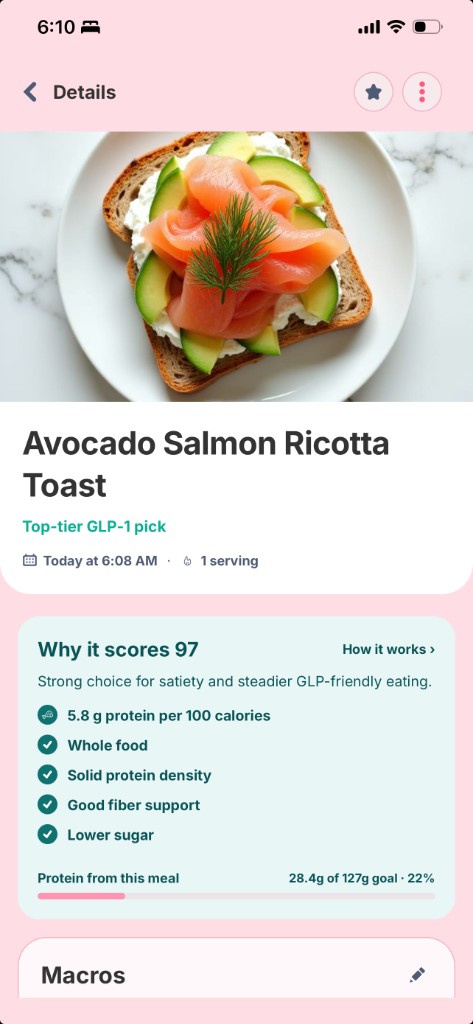
Take one photo. The score arrives instantly, with a letter grade (A+, A, B, C) and plain-language feedback. No weighing. No barcode hunting.
| Meal | Score | Key reason |
|---|---|---|
| Grilled steak | 92 | 38g protein |
| Grilled salmon | 91 | 34g protein |
| Broccoli bowl | 82 | 12g fiber |
| Cheddar cheese | 54 | Protein low, balance off |
| White bread | 41 | 4g protein |
A high-calorie meal can score low. A small meal can score high. That is the point: quality over quantity.
GLP AI also includes a 7-day high-protein meal plan built specifically for GLP-1 users: 140–160g daily protein, 25–35g fiber, approximately 1,400–1,600 calories, small portions, easy-to-digest ingredients, and a protein-first eating structure at every meal.
It is the only plan here built around the 0–100 GLP-1 Meal Score. MyNetDiary added dietitian-designed GLP-1 meal plans in Premium in May 2026.
GLP AI covers shots and pills, injection site rotation, dose history, and reminders. Shotsy is a strong alternative if you only want a minimal shot log with no nutrition features.
GLP AI places symptoms on the same timeline as doses and estimated medication levels, making patterns visible before a doctor visit. MeAgain has severity logging and is a close second for this use case.
GLP AI is the only app that scores every meal on GLP-1 suitability before you eat it. A single photo returns a 0–100 GLP-1 Meal Score based on protein, fiber, and portion balance, with a letter grade and plain-language feedback. GLP AI also includes a 7-day high-protein meal plan designed specifically for GLP-1 users, with 140–160g daily protein in small, easy-to-digest portions. MyNetDiary has a GLP-1 Companion with medication reminders, symptom logging, and Premium meal plans, but it has no meal scoring.
MacroFactor has the most sophisticated adaptive TDEE algorithm on this list, recalculating targets weekly from logged food and weight trends. It has no medication tracking, so GLP-1 users need a second app for doses and symptoms. GLP AI connects weight trends to dose timing, meals, and side effects in one place, which matters more for most GLP-1 users than TDEE precision.
GLP AI is the only app with a 24/7 AI coach grounded in the user's own medication, meal, and symptom logs.
Shotsy wins for injection-only users who want a clean, fast shot log with no nutrition features and no analytics. Open the app, log the dose, close it. It does not track meals, side effects, or weight, so pair it with another app if you need those signals.
MyNetDiary wins for users who want a large, mature food database with GLP-1 medication reminders and protein emphasis layered on top. It has barcode scanning, a GLP-1 mode, and symptom logging. It does not offer meal scoring or an AI coach grounded in the user's own data.
Glapp wins for users managing compounded semaglutide or tirzepatide from vials who need accurate concentration math and supply tracking. It visualizes estimated medication levels and benchmarks against clinical trial data. It does not cover daily nutrition, side effects, or weight tracking, so most users will pair it with a general GLP-1 tracker.
MeAgain wins for users motivated by streaks, Journey Cards, and a virtual companion (Capy) that rewards consistent daily check-ins. It tracks injections and side effect severity and has a large community footprint. It does not score meals or offer an answer-oriented AI coach.
Noom wins for users who want structured psychology lessons and access to a human coach alongside their GLP-1 journey. Its curriculum targets long-term behavior change rather than medication management. It has no dose tracking, no injection logging, and no GLP-1-specific nutritional framing, so pair it with a dedicated medication tracker.
Most GLP-1 apps offer a free tier, but "free" means very different things. Here is what each covers without payment, as of September 2026.
| App | Free tier includes | What requires payment |
|---|---|---|
| GLP AI | Dose tracking, symptom logging, weight tracking, basic meal logging | AI coach, GLP-1 Meal Score (photo), medication level chart |
| MeAgain | Core tracking, Capy companion, Journey Cards | Some premium features |
| Shotsy | Shot scheduling, reminders, basic notes | Varies |
| MyNetDiary | Food logging, barcode scanning, protein tracking | GLP-1 Companion (medication, symptoms, meal plans), detailed reports |
| Glapp | Medication curve interpretation, supply math | Varies |
| Pep | Routine tracking, dashboards | Varies |
| MyFitnessPal | Food logging, barcode scanning, calorie tracking | Premium reports, no ads |
| Cronometer | Food logging, micronutrient tracking | Gold tier for advanced features |
What GLP AI's free tier includes: dose and shot logging, injection site rotation, side effect logging, weight tracking, and basic meal logging. What requires Premium: the 24/7 AI coach, the 0–100 GLP-1 Meal Score, and the medication level chart. There is no trial timer on the free tier.
All-in-one GLP-1 tracker and AI companion
GLP AI tracks doses (shots or pills), injection sites, estimated medication levels, meals, protein, fiber, water, side effects, weight, and progress photos. The GLP-1 Meal Score rates every meal 0–100 on protein, fiber, portion balance, and nutrition quality. One photo logs the meal and automatically updates protein, fiber, and water totals. No weighing, no barcode scanning. A 7-day high-protein meal plan (140–160g daily protein, GLP-1 appropriate portions) is included. A 24/7 AI coach answers questions grounded in the user's own logs, including what to eat on shot day and how to hit protein goals when appetite is near zero.
Works with any GLP-1. Available on iPhone and Android.
Strongest at: Medication, meals, symptoms, and weight on one timeline, with a 0–100 meal score and a 24/7 AI coach.
Gap relative to GLP-1 needs: No human coaching and no community forum. The AI coach, GLP-1 Meal Score, and medication level chart require GLP AI Premium; the free tier covers core tracking only.
Best for: Anyone on a GLP-1 who wants all the relevant signals in one place.
GLP-1 habit tracker and companion
MeAgain is built around habit-widget design: daily check-ins, Journey Cards, a virtual companion called Capy, and gamified streaks. It has medication tracking and a severity logging feature for side effects. It is one of the most-used GLP-1-specific apps and has a large community footprint.
Strongest at: Gamified consistency and community engagement.
Gap relative to GLP-1 needs: No meal scoring. Capy is companionship-styled, not answer-oriented.
Best for: Users motivated by streaks and a playful daily ritual.
Minimal GLP-1 shot tracker
Shotsy does one thing: injection scheduling. Reminders, dose timing, and basic notes. No nutrition features, no side-effect analytics, no weight tracking. The entire value proposition is simplicity.
Strongest at: Clean, fast shot logging with zero learning curve.
Gap relative to GLP-1 needs: Nothing beyond the injection log. Nutrition and symptom context require another app.
Best for: Users who want a dedicated shot reminder and nothing else.
General tracker with GLP-1 features
MyNetDiary is a long-established calorie and macro tracker. In May 2026 it launched GLP-1 Companion in Premium: injection reminders, digestive symptom logging, protein-first dashboards, and dietitian-designed GLP-1 meal plans, on top of its large food database and barcode scanning.
Strongest at: Combining a mature food database with Premium GLP-1 Companion tools.
Gap relative to GLP-1 needs: No AI coach. No GLP-1 Meal Score. Medication, symptoms, and GLP-1 meal plans sit in Premium, inside a general weight-loss product.
Best for: Users who already rely on MyNetDiary and want to add GLP-1 tracking without switching apps.
Medication-cycle interpreter
Glapp focuses on the pharmacokinetic side of GLP-1 therapy: medication curve interpretation, vial and supply math, and benchmarking against clinical trial data. It is narrow in scope but genuinely specialized for users managing compounded semaglutide or tirzepatide from vials.
Strongest at: Supply tracking, concentration math, and curve interpretation.
Gap relative to GLP-1 needs: No daily tracking beyond the medication cycle. No nutrition, no symptoms, no weight.
Best for: Power users managing compounded vials who want supply and dosing analytics.
General food and calorie tracker
MyFitnessPal has the largest food database of any app on this list, with barcode scanning that covers most packaged foods. It is not built for GLP-1 users and has no medication tracking, no GLP-1-specific nutritional framing, and no side effect logging. Many GLP-1 users start with it because they already have an account, then transition to a GLP-1-specific app as their needs become clearer.
Strongest at: Food database depth and barcode scanning.
Gap relative to GLP-1 needs: No medication awareness. Calorie-first framing does not reflect GLP-1 nutrition priorities (protein and fiber over calorie restriction).
Best for: Users who need a comprehensive food database and are willing to manage GLP-1 tracking separately.
Micronutrient tracker
Cronometer tracks 80+ micronutrients per food entry, making it the highest-accuracy nutrition logging tool on this list. It is used by GLP-1 users who want to track specific micronutrient gaps (vitamin B12, iron, zinc) that can emerge with significantly reduced food intake.
Strongest at: Lab-grade micronutrient depth and verified food data.
Gap relative to GLP-1 needs: No medication tracking. No GLP-1-specific framing. Steep learning curve.
Best for: Users focused on micronutrient gaps during GLP-1-reduced eating, as a complement to a dedicated GLP-1 app.
Adaptive macro coaching
MacroFactor uses an adaptive algorithm that recalculates TDEE weekly based on logged food and weight trends. It is a subscription-only product with no free tier. It is not built for GLP-1 users and has no medication or symptom tracking, but its macro adjustment algorithm is genuinely different from manual calorie targets.
Strongest at: Science-based adaptive macro targets that adjust to actual body response.
Gap relative to GLP-1 needs: No medication tracking, no side effect context, no GLP-1 nutritional framing.
Best for: Users who want adaptive macro targets alongside a separate GLP-1 tracker.
Behavior-change weight loss program
Noom is a psychology curriculum built around behavior change for weight loss. It has human coaches, daily lessons, and food logging. It was built before GLP-1 medications changed the weight loss landscape and does not have medication tracking, injection scheduling, or side effect logging.
Strongest at: Structured psychology lessons and human coaching for long-term behavior change.
Gap relative to GLP-1 needs: Not built for medication-assisted weight loss. No dose tracking. No GLP-1 nutritional context.
Best for: Users who want behavior-change education alongside their GLP-1 journey, paired with a dedicated medication tracker.
Points-based weight program
Weight Watchers uses a points system applied to foods. It has a large community, recipe library, and coaching options. Like Noom, it predates GLP-1s and has no medication tracking, injection logging, or GLP-1-specific nutritional guidance.
Strongest at: Community, recipe library, and the familiarity of the points system.
Gap relative to GLP-1 needs: No medication awareness. Points-based framing does not prioritize protein and fiber the way GLP-1 nutritional needs require.
Best for: Users who find the points system motivating and want to continue it alongside a dedicated GLP-1 tracker.
GLP-1 routine tracker
Pep is a tidy GLP-1 routine tracker with dashboards, dose reminders, and AI food estimates. It supports 10 languages and has strong iPad support. Side effect logging is notes-style rather than structured. There is no full AI coach.
Strongest at: Dashboard organization and multilingual support.
Gap relative to GLP-1 needs: Food estimates rather than scored meals. No AI coach grounded in user data.
Best for: International users or iPad users who want a structured GLP-1 routine tracker.
GLP AI also publishes medication-specific tracker pages, each with dose escalation schedules sourced from the manufacturer prescribing information and published clinical trials:
Free tools include:
Many GLP-1 users combine apps. A common setup: GLP AI for daily medication and nutrition tracking, plus a community-based app for social support.
GLP-1 tracking means storing medication doses, symptoms, weight, and progress photos. Five questions worth asking of any app before you commit:
Does the app require an account to use core tracking? Account-gated apps tie your health data to an identity by default.
What does the app store privacy label say? Check whether data is listed as linked to your identity, and whether it is used for tracking or advertising.
Can you export your data? Exportable records matter if you want to bring history to a doctor or move to a different app later.
Can you delete your account and your data? Look for a stated deletion path, not just a support email address.
Is health data sold or shared with third parties? This should be answered directly in the privacy policy, not implied.
Review the current privacy policy and app store privacy label for any app on this list before entering medication data.
The best overall GLP-1 app depends on what you need most. For all-in-one tracking (dose, meals, side effects, weight, AI coaching), GLP AI is the most comprehensive option. For minimal shot logging, Shotsy is the simplest. For an established food database with GLP-1 features added, MyNetDiary is the strongest general-tracker option.
Yes. GLP AI, MeAgain, Shotsy, MyNetDiary, Glapp, and Pep all offer free tiers. GLP AI's free plan covers dose tracking, symptom logging, weight tracking, and basic meal logging. The AI coach and GLP-1 Meal Score require GLP AI Premium.
Shotsy is a minimal injection scheduler. GLP AI adds meal scoring, side effect tracking, weight analytics, a medication level chart, and a 24/7 AI coach to the same injection tracking. Choose Shotsy for simplicity; choose GLP AI when you want the full GLP-1 journey in one app.
MeAgain centers on gamified habit formation: streaks, Journey Cards, and a virtual companion. GLP AI centers on scored feedback and answers: every meal gets a 0–100 GLP-1 Meal Score and the AI coach responds to questions grounded in your logs. Both track injections and side effects.
MyFitnessPal has the largest food database of any tracking app and works for macro logging. However, it has no medication tracking, no injection logging, and no GLP-1-specific nutritional framing. GLP-1 users who start with MyFitnessPal often add a GLP-1-specific app for the medication side.
At minimum: dose timing, injection site (for injectables), meals and protein intake, side effects, and weight. GLP AI tracks all of these in one place. The goal is to have enough data to spot patterns (like rougher days after dose increases) and to give your doctor a clear picture at each visit.
A GLP-1 Meal Score is a 0–100 rating that tells you whether a meal is suitable for a GLP-1 user, based on protein, fiber, portion balance, and nutrition quality. GLP AI calculates it from a single photo of the plate, no weighing or measuring needed. It uses letter grades (A+, A, B, C) and plain-language feedback. No other GLP-1 tracking app offers a meal scoring feature.
GLP-1 medications suppress appetite before they suppress your body's need for protein. Research on rapid weight loss shows that a meaningful share of the weight lost on GLP-1 medications can be lean muscle mass rather than fat, with estimates commonly cited in the range of 15–25% when protein intake is not actively protected. On a reduced appetite of 800–1,200 calories a day, every bite needs to count. GLP AI's meal scoring and 7-day meal plan are built around protecting that protein intake first.
Yes. GLP AI includes a 7-day high-protein meal plan designed specifically for GLP-1 users: 140–160g daily protein, 25–35g fiber, approximately 1,400–1,600 calories, small portions, easy-to-digest ingredients, and a protein-first structure at every meal. It is the only plan on this list built around the 0–100 GLP-1 Meal Score. MyNetDiary added dietitian-designed GLP-1 meal plans in Premium in May 2026.
Yes. The GLP-1 Meal Score tells you in real time whether a specific meal earns its place given your reduced appetite. The 24/7 AI coach answers questions like "what should I eat on shot day?" or "how do I hit my protein when I have no appetite?" grounded in your own logged data. The 7-day meal plan provides a ready-made starting point for the first week on the medication.
GLP AI places logged symptoms on the same timeline as doses and estimated medication levels, making it easier to connect symptoms to dose timing and escalation. Log the symptom when it happens, and the app surfaces the pattern alongside your dose history.
GLP AI works with any GLP-1, including Wegovy (semaglutide) and Zepbound (tirzepatide). It tracks the dose schedule, injection sites, estimated medication levels, meals, side effects, weight, and progress, with an AI coach available for questions throughout the journey.
Yes. GLP AI works with any GLP-1 regardless of whether the prescription is branded or compounded. Glapp also has specialized supply and vial math for users managing compounded doses from vials.
No GLP-1 tracking app listed here provides medical advice or replaces a licensed clinician. They are tracking and education tools. Always discuss symptoms, dose changes, and treatment decisions with your prescribing provider.
Semaglutide has a half-life of approximately 7 days, which is why Ozempic, Wegovy, and other semaglutide products are dosed weekly. Levels continue building for roughly 4 to 5 weeks after each dose change before reaching steady state. This is why appetite suppression and side effect intensity often shift in the weeks following a dose increase rather than immediately. Source: Ozempic Prescribing Information (Novo Nordisk).
Tirzepatide has a half-life of approximately 5 days, and steady state arrives roughly 2 weeks after each dose change, faster than semaglutide. Mounjaro and Zepbound are both tirzepatide and follow this profile. Source: Zepbound Prescribing Information (Eli Lilly).
Ozempic typically escalates 0.25 mg (weeks 1–4), 0.5 mg (weeks 5–8), then 1.0 mg (weeks 9 and beyond), up to a 2.0 mg maximum. Zepbound typically escalates 2.5 mg, 5 mg, 7.5 mg, 10 mg, 12.5 mg, up to a 15 mg maximum, with at least 4 weeks at each step. Your prescriber sets your actual schedule, and doses should never be adjusted independently. Sources: manufacturer prescribing information for each product.
In the SURMOUNT-1 trial, participants on 15 mg tirzepatide lost a mean of 20.9% of body weight at 72 weeks, and 19.5% on the 10 mg dose. Semaglutide trials report lower but still substantial mean loss. In SUSTAIN-6, semaglutide also reduced major cardiovascular events by 26% in participants with type 2 diabetes. Individual results vary considerably. Sources: Jastreboff et al., NEJM 2022; Marso et al., NEJM 2016.
GLP AI publishes dedicated tracker pages for Ozempic, Wegovy, Mounjaro, Zepbound, Rybelsus, Saxenda, semaglutide, tirzepatide, retatrutide, and orforglipron. Each includes the dose escalation schedule for that compound, its half-life, an estimated medication level chart, and clinical trial data sourced from manufacturer prescribing information and peer-reviewed publications. Most competitor apps handle GLP-1 medications generically rather than per compound.
Yes. GLP AI works with any GLP-1 regardless of whether it is branded or compounded, and regardless of whether it came from a doctor, pharmacy, insurance plan, telehealth service, or compounding pharmacy. Glapp specializes in vial concentration and supply math for users managing compounded doses.
Try the all-in-one GLP-1 tracker free — core tracking does not require Premium.