


Medical Disclaimer
This article is for informational purposes only and does not constitute medical advice. The information provided should not be used for diagnosing or treating a health condition. Always consult your healthcare provider before starting, stopping, or changing any medication or treatment plan. Individual results may vary.
Yes — diarrhea on Zepbound is normal, common, and usually temporary. It's one of the medication's most frequent side effects, it shows up most often in the first weeks and after dose increases, and for most people it settles as the body adjusts. It is almost always manageable at home — but there are specific warning signs that mean you should call your doctor, listed below.
How common is it? The actual numbers
From the current Zepbound prescribing information (USPI Table 1 — pooled weight-reduction Studies 1 and 2):
Diarrhea on Zepbound: reported by 19% of people at 5 mg, 21% at 10 mg, and 23% at 15 mg — versus 8% on placebo. It sits alongside nausea and constipation as the medication's most common side effects, and it is dose-dependent: higher dose, higher likelihood.
Two things worth reading out of that box: most people on Zepbound don't get diarrhea — and if you do, you're not an outlier, you're in the label.
Why Zepbound causes diarrhea
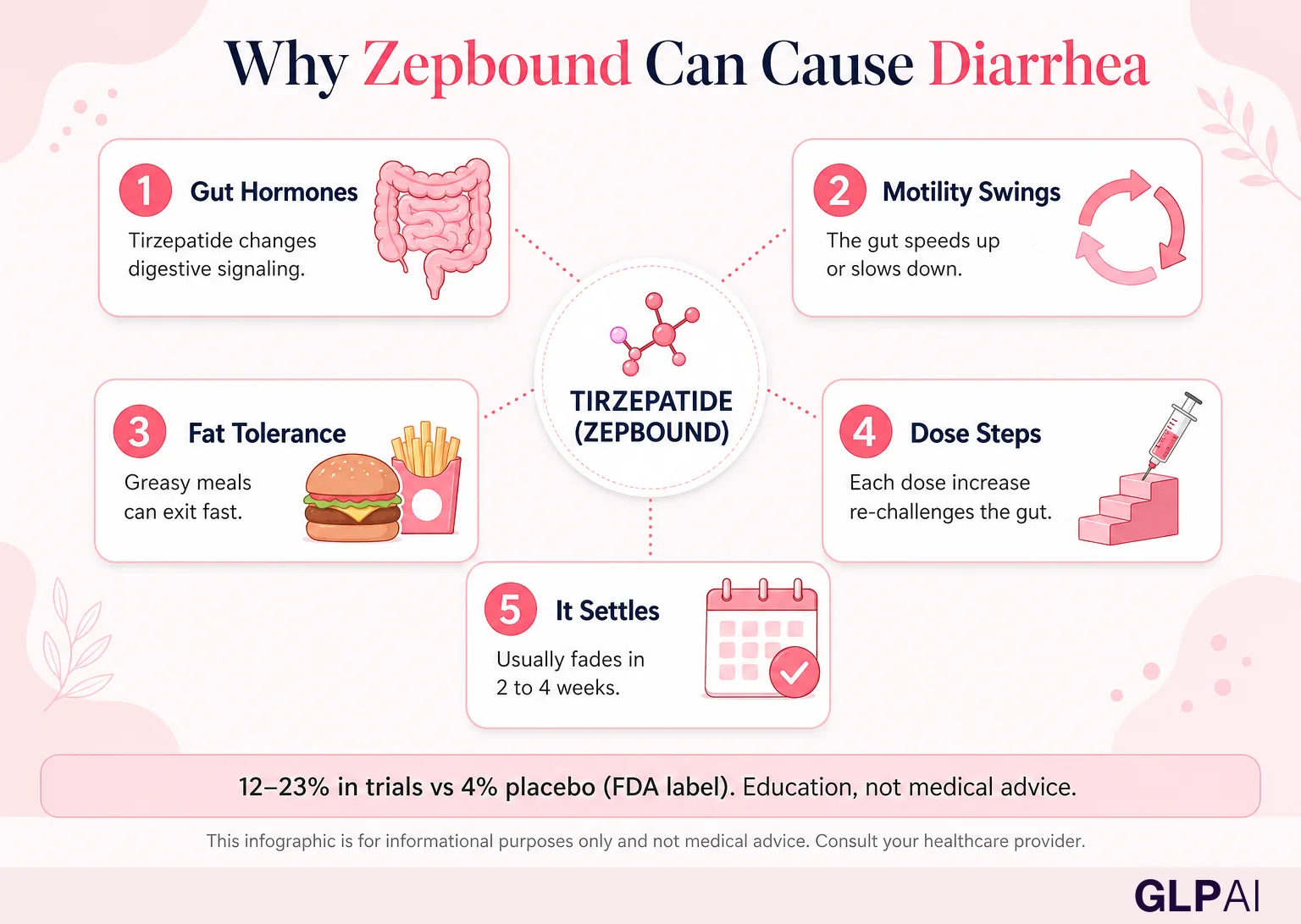
Tirzepatide (Zepbound's active ingredient) mimics two gut hormones, GLP-1 and GIP. That's what quiets appetite — but the same signaling changes how your digestive tract moves and secretes fluid:
- Motility swings. The gut is adjusting to new hormonal signaling; for some people it slows (constipation), for others it speeds up or alternates. Community threads regularly describe both in the same month.
- Fat tolerance drops. Slower stomach emptying means greasy or fried meals sit longer and can exit fast and unpleasantly. A heavy restaurant meal is the most commonly reported trigger.
- Dose steps reset the clock. Each titration step (2.5 → 5 → 7.5 mg and up) re-challenges your gut. A calm month followed by a rough week after moving up is the expected shape, not a setback.
How long does it last?
- Typical episode: a few days, clustered in the 24–72 hours after a shot for people who notice a shot-day rhythm.
- Typical phase: the first 2–4 weeks on a new dose, fading as your body adapts.
- What it shouldn't be: constant, worsening, or dehydrating. Diarrhea lasting more than a few days without improvement is a call-your-doctor situation, not a wait-it-out one.
If you're not sure whether yours follows a dose pattern, that's exactly what a symptom log answers in two or three weeks of data.
The relief protocol
A practical sequence, from first-line to escalation:
- Hydrate with electrolytes, not just water. Diarrhea costs sodium and potassium; broth, electrolyte packets, or oral rehydration mixes beat plain water.
- Go bland and low-fat for 24–48 hours. Rice, bananas, toast, applesauce, plain chicken, eggs. Skip fried food, heavy dairy, and sugar-free products (sugar alcohols like sorbitol are diarrhea accelerants).
- Shrink portions. Half-size meals, eaten slowly, are easier on a gut that's still adjusting — this also helps the nausea that often travels with it.
- Favor soluble fiber. Oats, bananas, and psyllium absorb water and firm things up; a giant raw salad does the opposite on a bad gut day.
- Ask your prescriber about anti-diarrheal medication. Over-the-counter options like loperamide are commonly discussed, but whether and when to use them on Zepbound is your clinician's call — especially if episodes are frequent.
- If it recurs at every dose increase, raise it at your next appointment. Slower titration is a standard, label-supported response — but it's a prescriber decision, never a self-adjustment.
What to track (and why it changes the conversation)
"I've had some diarrhea" gets you a shrug; "loose stools on days 2–3 after each of my last three shots, none by day 5" gets you an actual plan. Log each episode with date and severity in the side effect tracker, alongside your shot days. Meals matter too — logging food with the GLP-1 Meal Score makes the greasy-meal trigger visible instead of anecdotal. The app turns both into a timeline you can hand your prescriber.
When to call your doctor
Contact your clinician promptly for any of these:
- Diarrhea lasting more than 3 days without improvement
- Signs of dehydration: dizziness, dark urine, dry mouth, rapid heartbeat — GLP-1 labels specifically warn that dehydration can stress the kidneys
- Blood in stool or black, tarry stools
- Severe abdominal pain, especially pain radiating to the back with vomiting (pancreatitis is a labeled warning) or right-upper-belly pain (gallbladder)
- Fever alongside the GI symptoms
- You can't keep fluids down
None of these are "tough it out" symptoms — and reporting them is not a reason to be embarrassed. Every thread on this topic is full of people who waited too long.
Zepbound Diarrhea FAQ
How long until Zepbound diarrhea goes away?
For most people, episodes last a few days and the tendency fades within 2–4 weeks on a given dose as the body adjusts. Dose increases can briefly restart it. Diarrhea that persists beyond a few days without improving warrants a call to your prescriber.
How do I stop diarrhea fast on Zepbound?
Hydrate with electrolytes, switch to bland low-fat foods for a day or two, avoid sugar alcohols and greasy meals, and keep portions small. Ask your prescriber before using over-the-counter anti-diarrheals like loperamide — they're commonly used, but the timing should be their call.
Does diarrhea mean Zepbound is working?
No. Diarrhea is a side effect of the hormonal signaling, not a sign of effectiveness. People with zero GI side effects lose weight just as well. Judge the medication by appetite, food noise, and weight trend — not by gut turbulence.
Will it come back every time my dose increases?
It can — each titration step re-challenges your digestive system, and a rough week after moving up is common. If it happens at every step or gets worse, your prescriber may slow the titration schedule.
What are the symptoms of Zepbound pancreatitis?
Persistent, severe abdominal pain — often radiating to the back — with or without vomiting, is the labeled warning sign of pancreatitis. That is different from cramping that accompanies a diarrhea episode and resolves with it. Severe or persistent pain means stop guessing and call your doctor or seek urgent care.
Sources verified 2026-09-11
- Zepbound prescribing information (current USPI) — Table 1 diarrhea rates in the pooled weight-reduction trials (placebo 8%; 5 mg 19%; 10 mg 21%; 15 mg 23%), plus dehydration/renal and pancreatitis warnings. Clinically reviewed by Teresa Maze, RDN, after this correction.
- Zepbound.lilly.com — Managing Possible Side Effects (manufacturer guidance).
- Patterns aggregated from public GLP-1 user reports (paraphrased; no individual accounts reproduced).
GLP AI
Editorial
Educational content from the GLP AI team about living on a GLP-1. Clinical review is credited by name on pages a reviewer has checked. Not medical advice.
Read more
Drinking Alcohol on GLP-1: A Complete Safety Guide 2026
Drinking alcohol on GLP-1 medication: why it feels different, key risks, a practical one-drink plan, what to track, and when to stop and call a doctor.

Protein Shakes for GLP-1 Users: What to Look For + 12 Picks
The best protein shakes for GLP-1 users: what to look for (20g+ protein, low sugar, easy on nausea), 12 real picks with numbers, and how many you need.
What Is Food Noise? Why GLP-1s Quiet It
What is food noise? The constant mental chatter about food, explained — what causes it, how to tell if you have it, and why GLP-1s turn the volume down.