


Medical Disclaimer
This article is for informational purposes only and does not constitute medical advice. The information provided should not be used for diagnosing or treating a health condition. Always consult your healthcare provider before starting, stopping, or changing any medication or treatment plan. Individual results may vary.
You're doing well on your GLP-1 medication. Your appetite is down, your routine is getting easier, and then a normal life question shows up — a birthday dinner, a wedding, a patio drink with friends. You wonder whether one glass of wine, one beer, or one cocktail is still fine.
For people on GLP-1 medication, drinking alcohol isn't automatically forbidden. But it often doesn't feel the way it used to. That's where people get caught off guard. They assume their old tolerance still applies, then end up nauseated, dizzy, dehydrated, or more impaired than expected.
The key issue isn't usually a direct chemical clash. The bigger issue is that GLP-1 drugs can change how your stomach empties, how alcohol reaches your bloodstream, and how your body experiences the drink. Once you understand that, safer choices become much easier.
GLP AI is the GLP-1 tracker and AI companion — use it to line up dose day, meals, hydration, and how you felt after a drink so your pattern is yours, not a generic rule.
Decisions about alcohol belong with you and your clinician — especially if you have diabetes or a history of pancreatitis, liver disease, or alcohol use disorder.
Can you drink alcohol on GLP-1 medication?
Yes, in many cases you can — with caution and different expectations.
Medical explainers commonly note there isn't a classic “drug–drug” chemical interaction between alcohol and GLP-1 medicines such as semaglutide or tirzepatide. At the same time, alcohol can worsen shared side effects like nausea, vomiting, and dehydration, and it can raise hypoglycemia risk in people with type 2 diabetes. Overviews such as WebMD on Ozempic and alcohol stress that “no direct interaction” is not the same as “no real concern.”
What changes in real life
You used to handle two drinks at dinner. Now you're on Wegovy, Ozempic, Mounjaro, or Zepbound. You order the same drink, at the same pace. Your body is not operating under the same conditions.
You may feel full earlier. You may get nauseated halfway through. The buzz may feel delayed, then stronger than expected. Or you may lose interest after a few sips.
Bottom line: If you choose to drink, start from the assumption that your old “normal” may no longer be reliable.
A safer mindset
A better question than “Am I allowed to drink?” is: “What happens in my body now if I drink?”
Start slower, eat first, and watch for symptoms that matter — instead of testing old limits.
Why alcohol feels different on GLP-1s
Most advice stops at “drink in moderation.” The more useful explanation is delayed gastric emptying.
The stomach timing problem
GLP-1 medications slow the rate at which food and liquid leave the stomach — like a funnel with a narrower opening. Things still move through, but more slowly and less predictably.
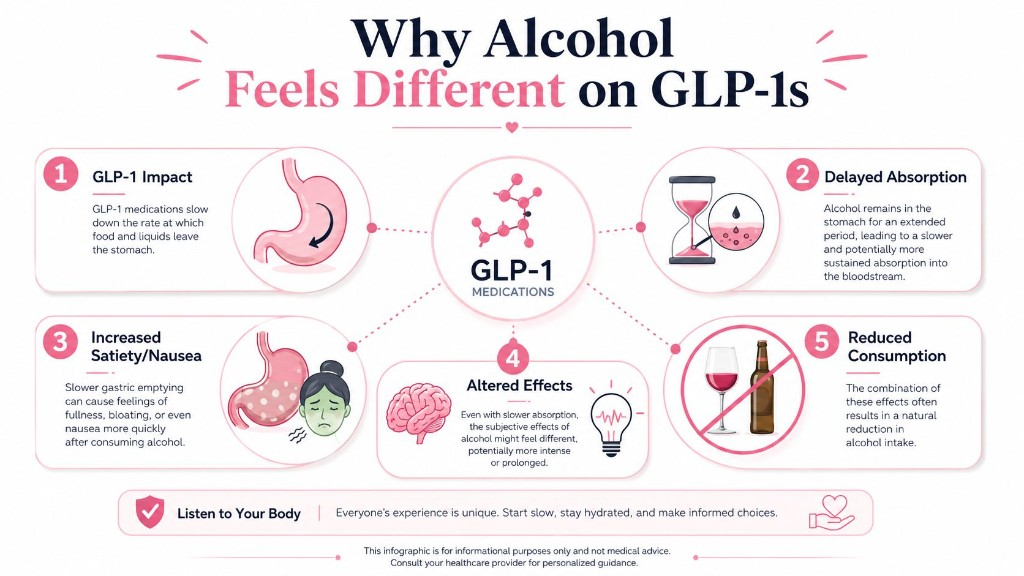
That timing change matters for alcohol. Delayed emptying can make absorption less predictable, which helps explain why some people feel intoxicated differently than their historical tolerance would suggest — sometimes later, messier, and harder to judge.
For timing between weekly doses, a GLP-1 half-life calculator (or the tirzepatide / Mounjaro calculator) can frame where you are in the week. It does not replace your own symptom tracking or medical advice.
Why your old tolerance may not apply
Tolerance assumes familiar conditions. GLP-1 therapy changes some of them. You may drink too quickly because you don't feel much at first — then effects arrive later, with nausea or dizziness on top.
There's another layer: research reviewed in an NIH-indexed article on GLP-1 receptor agonists and alcohol outcomes discusses associations with reduced alcohol consumption and lower alcohol-related harms in some studies, with mechanisms that include slowed gastric emptying and reduced rewarding effects of alcohol. Your body may not just process alcohol differently — it may also want it less.
Key health risks of combining alcohol and GLP-1s
Side effects can stack
Alcohol and GLP-1 medications can both upset the stomach. If you already deal with nausea, reflux, bloating, or low appetite after your injection, alcohol can push those symptoms further — especially on an empty stomach.
A common mistake is blaming “that one bad drink.” Often it's the combination of slower emptying, less food intake, and alcohol.
Low blood sugar can be easy to miss
For people with type 2 diabetes, alcohol can lower blood sugar and mask warning signs. Shakiness, sweating, confusion, or feeling “off” can be dismissed as tipsiness when hypoglycemia is the issue. Follow your care team's monitoring advice before, during, and after drinking.
If you have diabetes, don't judge safety by how “normal” you feel after the first drink.
Dehydration builds faster than people expect
Reduced appetite can mean less fluid intake. Nausea makes water less appealing. Alcohol adds another dehydration layer — one reason “weird” hangovers show up on GLP-1s.
Watch for:
- Persistent nausea that keeps building
- Repeated vomiting / can't keep fluids down
- Marked dizziness or weakness when standing
- Mental fog or confusion (especially with diabetes)
- Very poor oral intake all evening
A practical guide to safer drinking on GLP-1s
If you decide to drink, the goal is harm reduction — more predictable, less likely to trigger side effects.
A simple plan before and during a drink
- Eat first — a real meal or substantial snack beats “a few crackers.”
- Choose one drink, not several options — mixing makes patterns harder to see.
- Skip sugary mixers and heavy carbonation when possible — many clinicians advise simpler drinks, roughly one standard drink per occasion, and one glass of water per alcoholic drink.
- Sip, then pause — don't order a second before you know how the first lands.
- Be more cautious near injection day — GI effects often feel strongest then.
Practical rule: If your stomach already feels unsettled that day, skip the alcohol.
Safer drinking — do's and don'ts
| Do | Don't |
|---|---|
| Eat before drinking | Drink on an empty stomach |
| Limit yourself to one standard drink | Assume your old tolerance still applies |
| Drink water with each alcoholic beverage | Ignore early nausea, bloating, or dizziness |
| Pick simpler drinks without sugary mixers | Lean on soda-heavy or very sweet mixers |
| Go slowly and wait before deciding on more | Drink at your old pace |
| Monitor glucose closely if you have type 2 diabetes | Assume low blood sugar will be obvious |
Social extras that help: nurse one drink for the event; have an exit line (“I'm good with this one”); stop at the first warning sign.
How GLP AI helps you find your pattern
Generic advice only goes so far. People respond differently to medication, dose timing, meals, and drink type.
Generic advice has limits
One person may tolerate a single glass of wine with dinner several days after an injection. Another may feel nauseated from a few sips after a low-appetite day. Logging turns “I think cocktails make me sick now” into a pattern.
Use a medication tracker (or your drug's tracker page) to line up dose timing with meals, symptoms, hydration, and how you felt after a drink.
What to track after a drink
- What you drank (beer, wine, spirits, sugary mixer?)
- How much (standard drinks)
- When relative to your injection
- Whether you ate first
- Symptoms afterward (nausea, vomiting, headache, reflux, dizziness, fatigue)
- Glucose readings if you have diabetes
The safest long-term strategy is based on your real pattern, not your pre-GLP-1 habits.
Red flags — when to stop and call a doctor
Stop drinking and get medical advice right away for severe or persistent abdominal pain, especially with vomiting — that can be a warning sign of a serious problem such as pancreatitis.
Seek urgent help for confusion, severe dizziness, fainting, blurred vision, or hypoglycemia symptoms that don't improve as expected, particularly with diabetes.
Other red flags: uncontrollable vomiting, inability to keep fluids down, worsening weakness or dehydration. If you're preparing for a visit, doctor-visit prep can help you bring nutrition, weight, and side-effect trends.
Don't try to “sleep it off” if symptoms are intense, unusual for you, or rapidly getting worse.
Frequently Asked Questions About GLP-1s and Alcohol
Does alcohol stall weight loss on GLP-1s?
It can make progress harder. Alcohol adds calories, can pull you away from protein intake, and may trigger poorer food decisions later in the evening. It isn't automatically 'forbidden,' but it often works against the habits that make GLP-1 treatment effective.
Will my desire for alcohol decrease on these medications?
It might. Some research and many patient reports describe reduced craving or less reward from drinking on GLP-1s. Others mainly notice stronger nausea. Either way, treat a drop in desire as information — not a failure of willpower.
What's the best type of alcohol if I still want a drink?
There isn't a universally best option. In practice, a single standard drink without a sugary mixer is often easier to manage than a sweet or heavily carbonated cocktail. Your own logged pattern matters more than a ranking of drinks.
Can I drink if I've never had side effects from my GLP-1?
You can still react differently to alcohol. Day-to-day tolerance of the medication does not guarantee that alcohol will feel the same as before treatment.
Is one drink always safe?
No. One drink may be fine for some people and too much for others depending on dose timing, food intake, hydration, diabetes status, and sensitivity. 'Start low and go slow' beats relying on old habits.
Sources verified 2026-07-16
- Educational overviews on GLP-1 medicines and alcohol (e.g. WebMD — Ozempic and alcohol).
- PMC article on GLP-1 receptor agonists and alcohol-related outcomes (research context; not personalized advice).
- Product labeling: GI adverse reactions and delayed gastric emptying are labeled considerations for GLP-1 receptor agonists — confirm details in the FDA label for your specific medicine.
GLP AI
Editorial
Educational content from the GLP AI team about living on a GLP-1. Clinical review is credited by name on pages a reviewer has checked. Not medical advice.
Read more
Zepbound Diarrhea: What Helps & When to Get Help
Diarrhea while taking Zepbound? Learn how common it is, what may help, what to track, and which warning signs need prompt medical attention.
Protein Shakes for GLP-1 Users: What to Look For + 12 Picks
The best protein shakes for GLP-1 users: what to look for (20g+ protein, low sugar, easy on nausea), 12 real picks with numbers, and how many you need.
What Is Food Noise? Why GLP-1s Quiet It
What is food noise? The constant mental chatter about food, explained — what causes it, how to tell if you have it, and why GLP-1s turn the volume down.