


Medical Disclaimer
This article is for informational purposes only and does not constitute medical advice. The information provided should not be used for diagnosing or treating a health condition. Always consult your healthcare provider before starting, stopping, or changing any medication or treatment plan. Individual results may vary.
Food noise is the constant, intrusive mental chatter about food — thinking about your next meal while you're still eating this one, replaying what you ate, negotiating with cravings all day. It's not ordinary hunger: it keeps running even when your body doesn't need fuel. GLP-1 medications like Zepbound, Wegovy, and Ozempic are known for quieting it, often within days of the first dose — for many people it's the first time they realize how loud it was.
Food noise, defined
"Food noise" isn't an official diagnosis — it's a community term that research has started to catch up with. Recent clinical commentary defines it as persistent, unwanted thoughts about food that feel distressing or disruptive — the person experiencing them doesn't choose them and often can't switch them off.
The key distinction is between hunger and preoccupation:
| Normal hunger | Food noise | |
|---|---|---|
| When it shows up | When your body needs fuel | Any time — including right after eating |
| What it feels like | A physical signal (empty stomach, low energy) | Mental chatter: planning, craving, negotiating, guilt |
| What turns it off | Eating a meal | Often nothing — eating quiets it briefly, then it restarts |
| Effect on the day | Background signal | Interrupts work, mood, and decisions |
If most of your food thoughts live in the right-hand column, that's food noise.
What causes food noise?
Nobody fully knows yet, but the working picture combines three things:
- Appetite hormones. Signals like ghrelin, leptin, and your body's own GLP-1 regulate hunger and fullness. When that system is dysregulated — which is common in obesity — the "seek food" signal can stay on well past the point of need.
- Reward wiring. Highly palatable food lights up dopamine-driven reward pathways. For some brains, food functions the way other compulsive rewards do: the thought loop self-reinforces.
- Set-point defense. Some researchers frame food noise as the brain defending a higher body-weight set point — turning up preoccupation with food whenever weight drops, which is one reason "just ignore it" advice fails.
That's also why food noise is not a willpower problem. It's a signaling problem — which is exactly what a signaling medication can address.
How do I tell if I have food noise?
Common patterns, aggregated from how GLP-1 users describe it:
- You plan dinner during breakfast, and lunch during dinner.
- Driving past a restaurant triggers a debate you didn't start.
- You know exactly what's in the pantry at all times.
- Eating "enough" doesn't end the thoughts; it just changes the topic to the next meal.
- Quiet moments default to food — boredom, stress, and celebration all route there.
Many people only recognize it in hindsight. A recurring line in community threads: "I never understood what food noise was until it was gone — it's so quiet in here."
Why do GLP-1s quiet food noise?
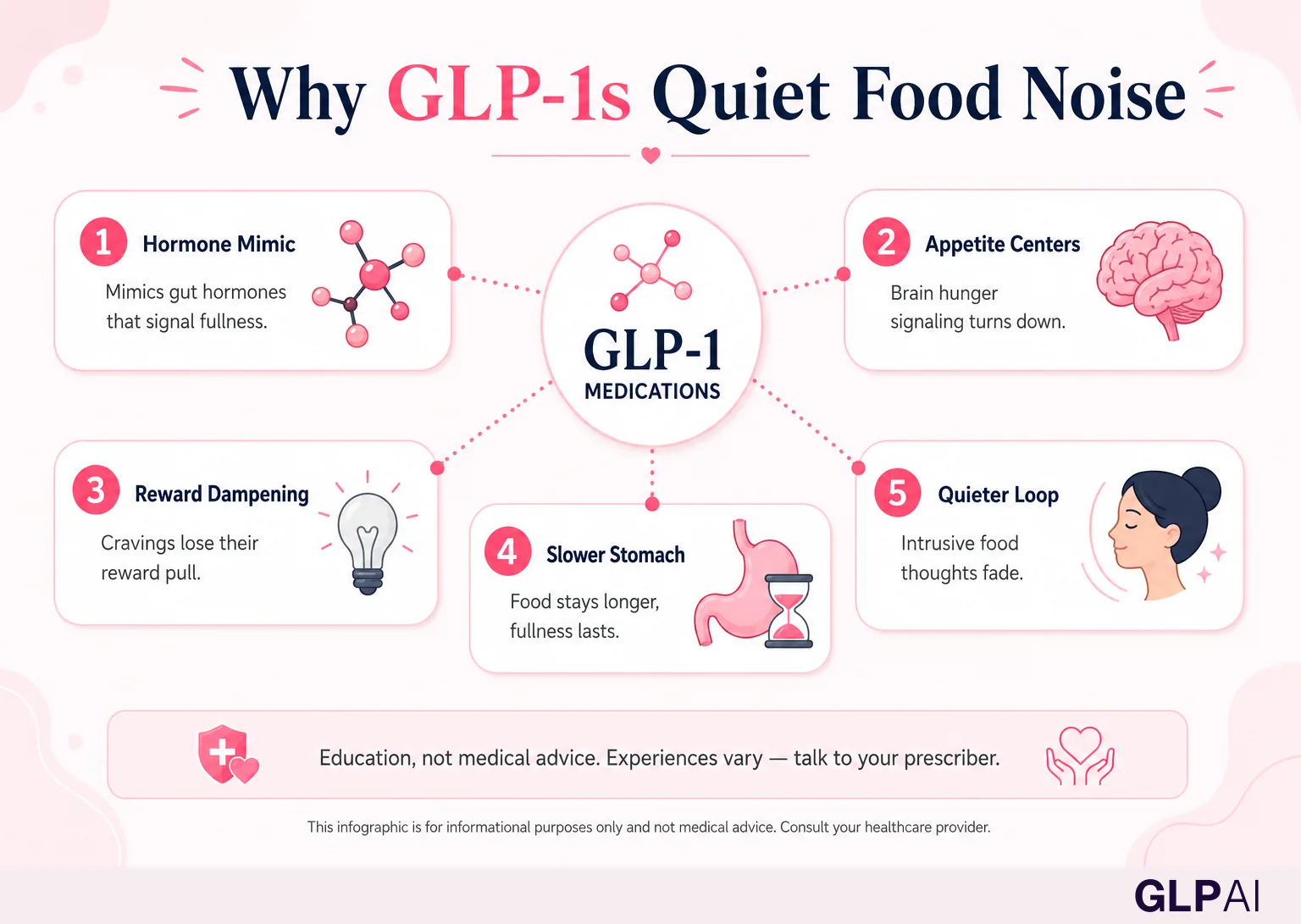
GLP-1 receptor agonists (semaglutide in Wegovy/Ozempic) and dual GIP/GLP-1 agonists (tirzepatide in Zepbound/Mounjaro) mimic gut hormones that act on appetite-regulating regions of the brain, slow stomach emptying, and increase satiety. The labeled effect is reduced appetite and earlier fullness.
The food-noise effect goes further than the label language: research is exploring how these medications dampen the reward response to food, not just physical hunger. Practically, users describe the same arc — the compulsive loop goes quiet, often in the first week, and food becomes something you decide about rather than something that pursues you.
Two honest caveats from the same community threads:
- The quiet isn't always empty. Some people notice a new preoccupation moves in — tracking shots, titration plans, side effects. Longtime users jokingly call it "Triz Noise." Give your brain something to do with the reclaimed bandwidth.
- The volume can drift back late in your dose week. Tirzepatide and semaglutide have roughly 5- and 7-day half-lives, so medication levels dip before your next shot. If food noise creeps back on days 6–7, that's a known rhythm, not a failure — see it plotted on the Mounjaro half-life calculator. It's worth logging and mentioning at your next appointment, not adjusting your dose over on your own.
Does food noise come back?
Sometimes, in three situations:
- End of dose week — the dip described above. Track it for two or three weeks before drawing conclusions.
- Dose plateaus — some people notice noise returning as their body adapts, which is a titration conversation for your prescriber.
- Stopping the medication — threads from people coming off Wegovy consistently say the noise returns and they wish they'd built habits while it was quiet. That's the strongest argument for using the quiet window deliberately.
Use the quiet: what to do while the noise is down
This is the part most articles skip. Food noise going quiet is an opportunity, not the finish line — appetite suppression makes it easier to eat well, but also easier to under-eat protein and default to whatever's around.
A simple practice: log your meals and let the GLP-1 Meal Score grade each one 0–100 on protein, fiber, and portion fit for GLP-1 users. When eating is driven by decisions instead of noise, a score turns each decision into a small, checkable win — and over weeks you get a record of what "quiet" eating actually looks like for you. If you're early in treatment, the what-to-expect guide covers when these changes typically show up.
Food Noise FAQ
Is food noise an ADHD thing?
They can overlap. ADHD brains are more prone to dopamine-seeking loops, and food is a fast reward, so many people with ADHD report loud food noise. But food noise occurs with and without ADHD — it's driven by appetite and reward signaling, not by any single diagnosis.
How do I know if I have food noise?
The test is persistence and intrusiveness: thoughts about food that show up when your body doesn't need fuel, keep running after you've eaten, and interrupt your day. If eating only quiets the thoughts briefly before they restart, that pattern is food noise rather than ordinary hunger.
Why does Ozempic stop food noise?
Ozempic (semaglutide) mimics the gut hormone GLP-1, which acts on appetite-regulating areas of the brain and increases satiety. Research also points to a dampened reward response to food. The result many users report is that intrusive food thoughts fade, often within the first weeks.
Does food noise come back after stopping GLP-1s?
Often, yes. People who stop commonly report the noise returning as the medication leaves their system. That's why clinicians emphasize building durable eating habits during treatment — and why stopping should always be planned with your prescriber.
Is food noise a real medical term?
It started as community language, but it now appears in peer-reviewed commentary, where it's described as persistent, distressing thoughts about food. There's no formal diagnostic definition yet — which is also why experiences of it vary so much.
Sources verified 2026-07-16
- Harvard Health — Understanding food noise and how to turn down the volume (definition and clinical framing).
- Cleveland Clinic — What Food Noise Is and How To Quiet It.
- Tufts Medicine — Food Noise Explained.
- Patterns aggregated from public GLP-1 user reports (paraphrased; no individual accounts reproduced).
- Product labeling: appetite reduction and delayed gastric emptying are labeled effects for GLP-1 receptor agonists — see the FDA prescribing information for your specific medication.
GLP AI
Editorial
Educational content from the GLP AI team about living on a GLP-1. Clinical review is credited by name on pages a reviewer has checked. Not medical advice.
Read more
Protein Shakes for GLP-1 Users: What to Look For + 12 Picks
The best protein shakes for GLP-1 users: what to look for (20g+ protein, low sugar, easy on nausea), 12 real picks with numbers, and how many you need.
What to Eat on Zepbound: Food List & Shot-Day Meals
What to eat on Zepbound: a practical food list, meal ideas with portions and protein, low-appetite options, and a free printable grocery checklist.
Drinking Alcohol on GLP-1: A Complete Safety Guide 2026
Drinking alcohol on GLP-1 medication: why it feels different, key risks, a practical one-drink plan, what to track, and when to stop and call a doctor.